

Magento AI Product Recommendations: 13 Types Every UK Retailer Should Use
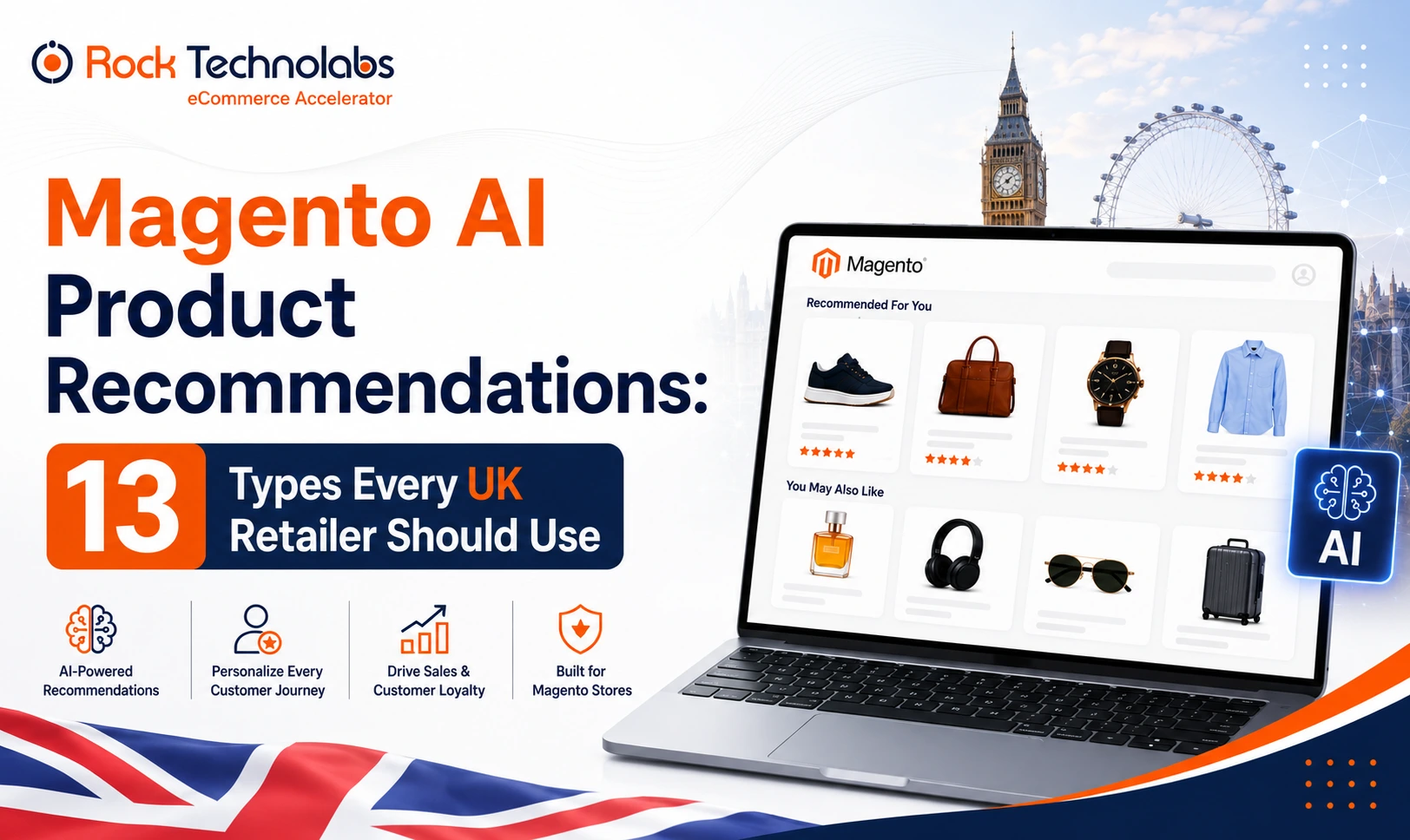
What do you think – what can be done in your Magento store so a customer who landed on your website sees the exact thing they were thinking of buying, and would make them change their mind and head to the checkout? Your answer might be the best experience, but how can this experience be created? One of the well-known techniques for ecommerce merchants is to leverage Magento AI product recommendation algorithms.
With all the data generated by both browsing and purchasing sessions, it would be a shame not to utilise it to suggest items for sale. In 2026, mere guessing in regards to customer preferences is a thing of the past. Below, learn what Magento AI recommendations are precisely, what benefit they bring to the table, and what are the 13 types of product recommendations every UK retailer should use.
What are Magento AI Product Recommendations?
These algorithms take care of providing the end-users with suggestions as to what items can be of interest to them. Adobe Commerce, the parent platform of Magento, uses Adobe Sensei to make these guesses based on each individual customer’s behaviour and characteristics.
It is important to note that the suggestions are made in real-time based on what a customer is browsing and buying. The recommendations appear on product, category, homepage, and cart pages and are managed through the Magento admin panel. There is not much to configuring such a system aside from setting it up initially, while the rest is handled automatically. As a result, you get to see an increase in average order value and customer engagement while also being able to provide each visitor with a unique experience.
In fact, companies that know how to personalise their offering can see an increase in revenue of up to 40% on average compared to their competitors, while recommendations can comprise between 25% and 35% of a company’s total revenue. It is clear that these tools are invaluable in the modern ecommerce platform, and therefore understanding each recommendation type and where it should be placed is critical.
13 Product Recommendation Types Every UK Retailer Should Use
Let’s discuss the actual types of recommendations that can be used within the Adobe Commerce platform.
1. Related Products
As the name implies, these are products that are related to the ones being browsed or purchased, for instance if a customer is searching for a smartphone then related products can feature phone cases, screen protectors, chargers, and other accessories thus it can increase the sale of store as it persuades the customer to add more related items in their cart.
2. Upsells
This recommendation type aims to promote higher-end alternatives to the ones being viewed or purchased. Essentially, upsells try to convince the customer to spend more money on a better version of the desired product. An example would be a more powerful laptop or a smartphone from the same manufacturer but with more RAM and a better graphics card. Upsells are commonly placed right below the Add to Cart button on a product page to encourage a sale at a higher price point.
3. Cross-sells
This plugin helps display complementary add-on items in the shopping cart so if a customer is going to buy a chair for a study room, cross-sells may suggest different types of tables that can be purchased with it. Moreover, you will notice that while upsells appear on product pages, cross-sells can be placed on the cart page to recommend additional items.
4. Customers Who Viewed This Also Viewed
This AI tool tracks the data of general behaviour of all visitors to suggest products that they browsed together, plus these suggested items do not have to be similar or related in any way but rather appear on the same page. As such, the Customers Who Viewed This Also Viewed recommendation type is great for helping the customer find related items that they may not have previously known about.
5. Recommended for You
Unlike most recommendation types listed above, Recommended for You does not rely on the general behaviour of visitors but rather focuses on a single individual. Adobe Sensei uses the data collected from an individual customer to suggest products based on their browsing and purchasing behaviour.
6. Trending Products
Trending products are another great way to utilise the data collected from your ecommerce platform. The Trending recommendation type features items that are popular among the target audience at the given time. Since trending products keep changing, this recommendation type serves to keep the homepage and category pages up-to-date without having to manually edit the layout.
7. Bought This, Bought That
This recommendation type focuses on items that are commonly purchased together. For instance, a coffee machine and a bag of coffee beans can be placed on the same product page or cart page to encourage the customer to buy them together. Not every combination makes sense, but there are many instances where such a combination can be beneficial for both the customer and the seller.
8. Visual Similarity
While most of the recommendations are manually created, Visual Similarity relies on Adobe Sensei to detect similar products and add them to the suggested list. It is a great option for the fashion and homeware industries to suggest clothing sizes or bedding sets. Since the recommendation engine analyses the image of an item, not its description, the Visual Similarity is best used on large-scale collections when a customer is browsing through the items in search of something specific.
9. Recently Viewed Products
As the name suggests, this recommendation type is all about recently viewed products. The customer can see exactly what they were looking at and save time clicking back and forth between the items they like. The recently viewed product recommendation is best placed on the homepage or product pages.
10. Most Viewed Products
While the Recently Viewed Products recommendation is customer-specific, Most Viewed Products keeps track of all visitors’ behaviour. It focuses on items that received much attention and popularity among the target audience. It is a great engagement tool to use on the homepage to show the visitor what others were looking at before them.
11. Recently Purchased Products
It is not uncommon for customers to come back to purchase the same items they bought previously. Therefore, the Recently Purchased Products recommendation is great for finding new buyers for established products. On the other hand, this recommendation type can be used to suggest additional items for the customer to purchase alongside the items they bought recently.
12. New Arrivals
New arrivals are a popular recommendation type that keeps the customer engaged while introducing them to new items. The New Arrivals recommendation type is best placed on category pages or a dedicated section for the newly added products. It primarily serves to attract returning customers who browse through your ecommerce platform to see what is new.
13. Top-Rated Products
Top-Rated Products recommendation relies on the feedback provided by the customers. The products featured in this section receive mostly positive feedback from the visitors, so it is a great way to demonstrate to your potential buyers what your loyal customers like about your business. Top Rated Products are best placed on category pages to show new visitors what your returning customers appreciate.
Rule-Based or AI-Powered Product Recommendations: Which is Better?
The rule-based approach should be seen as an entry-level product recommendation system that only requires basic technical expertise. It does not utilise machine learning algorithms but rather follows a set of predefined rules to suggest items for sale. Rule-based recommendations are great for organisations with smaller catalogues or seasonal variations that want to test the waters before investing in a more comprehensive system.
AI recommendations offer much more flexibility and precision than their rule-based counterparts. They can highlight combinations of products that would not have been possible otherwise while also being able to update themselves automatically as more data becomes available.
Additionally, Magento AI recommendations can offer different experiences to different customers based on their behaviour and characteristics, thus providing each visitor with a unique but relevant experience. It should be noted that many UK-based retailers fall somewhere in the middle, so it may be worth considering a hybrid approach that combines rule-based recommendations for seasonal variations and AI recommendations to drive sales.
Customer Segmentation to Get More Out of Recommendations
To truly maximise the value of product recommendations in your ecommerce platform, consider applying different recommendation types to different customers. It is essential to remember that every visitor is unique in terms of their browsing and purchasing behaviours. With that in mind, new customers should be recommended bestsellers and trending products because there is not much data to work with in the early stages of the journey. Returning visitors, on the other hand, will benefit from recommendations based on their past behaviour within the online store.
As for existing customers, they will appreciate seeing products that they purchased recently or being introduced to similar items. It is also crucial to note their session behaviour, so those who arrive on the website via a marketing campaign should see different recommendations than those who browsed the website organically. The same logic applies to logged-in versus logged-out visitors because the latter have much less data to work with.
Moreover, none of the above customer segmentation rules needs to be manually implemented as Adobe Sensei will handle it on its own once there is enough data to work with.
Wrapping Up
We hope that now you have a better understanding of how Magento AI product recommendations can help UK retailers create more personalised shopping experiences from related products and upsells to personalised and behaviour-based recommendations, each recommendation type serves a different purpose across the customer journey.
By combining the right Magento or Adobe Commerce capabilities with effective customer segmentation, retailers can deliver more relevant product suggestions; however, to implement all this in your Magento development process requires the assistance of certified Magento developers, and Rock Technolabs has 70+ such developers.

















 +1 917 722 7715
 +44 2037 698881